

Table of Contents
- 1. Acoustic Leak Detection – Why Sound Matters for Finding Hidden Leaks
- 2. Thermal Imaging Technology – Detecting Temperature Changes That Reveal Water Escape
- 3. Ground Penetrating Radar – Precision Mapping Without Breaking Your Foundation
- 4. Tracer Gas Detection – How We Pinpoint Leaks with Harmless Gas Tracers
- 5. Pressure Testing Systems – Confirming Leaks with Safe Pressure Analysis
- 6. Video Inspection Cameras – Visual Confirmation Through Your Existing Plumbing Lines
- 7. Moisture Mapping – Identifying Wet Zones Before Major Damage Occurs
1. Acoustic Leak Detection – Why Sound Matters for Finding Hidden Leaks
A slab leak is every homeowner’s nightmare. Water pooling under your foundation, mysteriously high water bills, and the fear of catastrophic repair costs can keep you awake at night. The challenge used to be that finding the leak meant breaking through your concrete slab, turning your yard or basement into a construction zone before repairs even began.
That’s no longer necessary. Modern non-destructive slab leak detection methods let us locate underground leaks with precision and zero damage to your home. Over our 25+ years serving Orange County, we’ve invested in the best technology available because early, accurate leak detection saves our customers thousands of dollars and months of stress.
Here are the seven most effective non-destructive methods we use to pinpoint exactly where your slab leak is hiding.
Water escaping under pressure from a broken pipe creates vibrations and sound. Acoustic leak detection equipment picks up these signals and helps us trace them to the source.
We use highly sensitive listening devices that amplify the sound of escaping water through the soil beneath your slab. By placing sensors at different points along your plumbing line and listening carefully to the pitch and intensity, we can narrow down the leak location to within a few feet. This method works especially well in Orange County’s dense residential areas where pipes run close together.
The beauty of acoustic detection is its simplicity. No chemicals, no radiation, no guesswork. We show up with equipment, listen systematically, and mark the problem area with precision. The data is objective and repeatable, which means if we test the same area twice, we get consistent results.
What to do next: If you notice a sudden spike in your water bill or damp spots appearing in unexpected places, acoustic leak detection is often our first diagnostic step. Call us at 949-235-1188 to schedule an on-site inspection.
2. Thermal Imaging Technology – Detecting Temperature Changes That Reveal Water Escape
Thermal imaging cameras detect infrared heat signatures invisible to the human eye. Water flowing through broken pipes under your slab is warmer or cooler than the surrounding soil, depending on whether it’s hot or cold water. These temperature differences show up clearly on our thermal imaging equipment.
We scan the floor surface and surrounding areas with a thermal camera, looking for unusual temperature zones that indicate water presence. The camera translates heat patterns into a visual map we can review with you in real time. This method is non-invasive and works regardless of soil type, which matters in Orange County where soil composition varies significantly from coastal to inland properties.
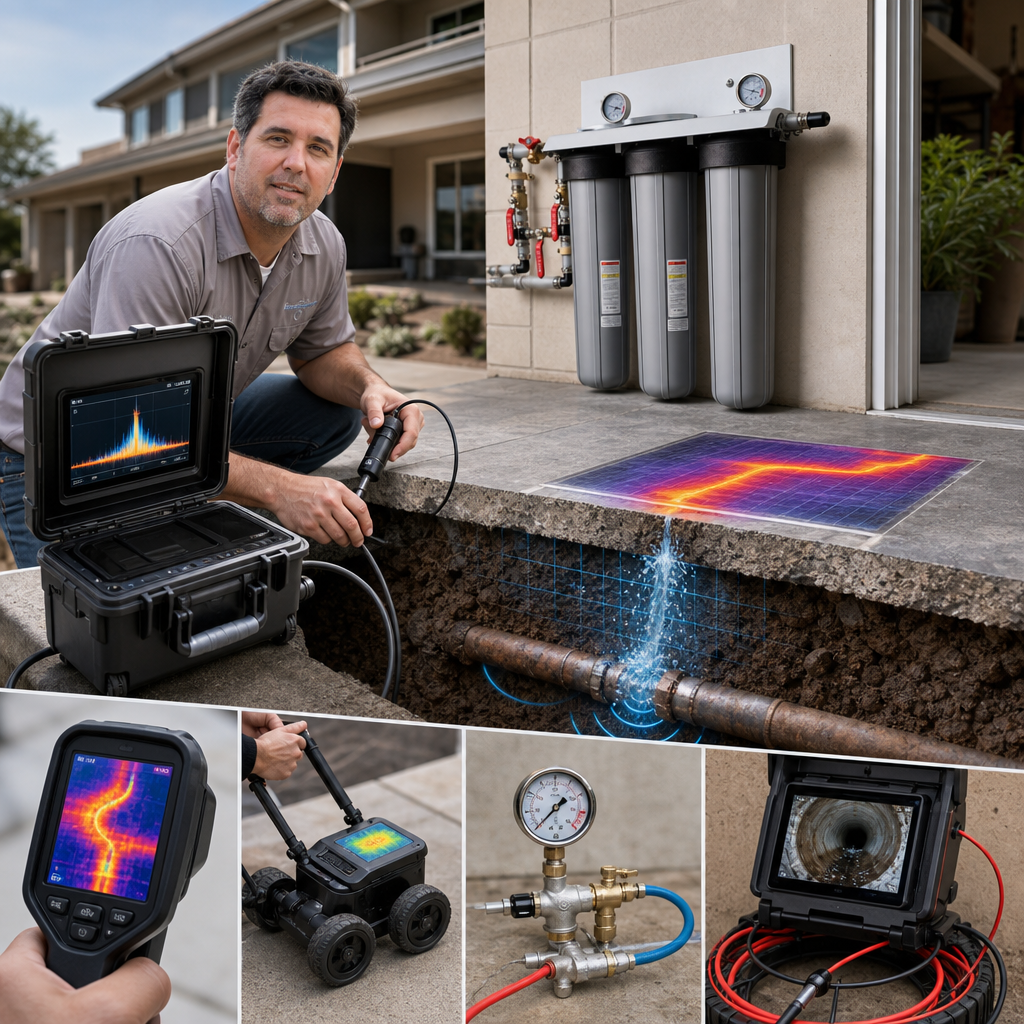
Thermal imaging is particularly useful when leaks involve hot water lines. The contrast between hot water and cool soil is dramatic and easy to spot. Because we can see the temperature differential in real time, we often catch patterns that hint at slow leaks developing over weeks rather than days.
What to do next: Thermal imaging gives us visual evidence we can show you. If we detect a temperature anomaly, we’ll explain exactly what it means and recommend whether additional testing is needed.
3. Ground Penetrating Radar – Precision Mapping Without Breaking Your Foundation
Ground penetrating radar (GPR) uses radio waves to create a detailed map of what’s happening beneath your slab. The equipment sends electromagnetic pulses into the ground and measures how they bounce back, creating a cross-section view of soil layers, pipes, and moisture pockets.
GPR is exceptionally accurate because it doesn’t just tell us there’s a leak; it shows us the exact depth, location, and sometimes the size of the water pocket. This technology is invaluable when we need to confirm a suspected leak before you commit to excavation. We can see your entire plumbing layout, identify which line is broken, and plan the most efficient repair strategy.
The advantage for Orange County homeowners is that GPR works in any soil condition, from dense clay to sandy soil common in our area. No digging required to gather this information. The radar scan produces detailed images that become part of your permanent diagnostic record, useful for insurance claims and future reference.
What to do next: We recommend GPR when acoustic or thermal results need confirmation, or when your property has complex plumbing layouts. It’s an investment that typically saves money by making repairs faster and more targeted.
4. Tracer Gas Detection – How We Pinpoint Leaks with Harmless Gas Tracers
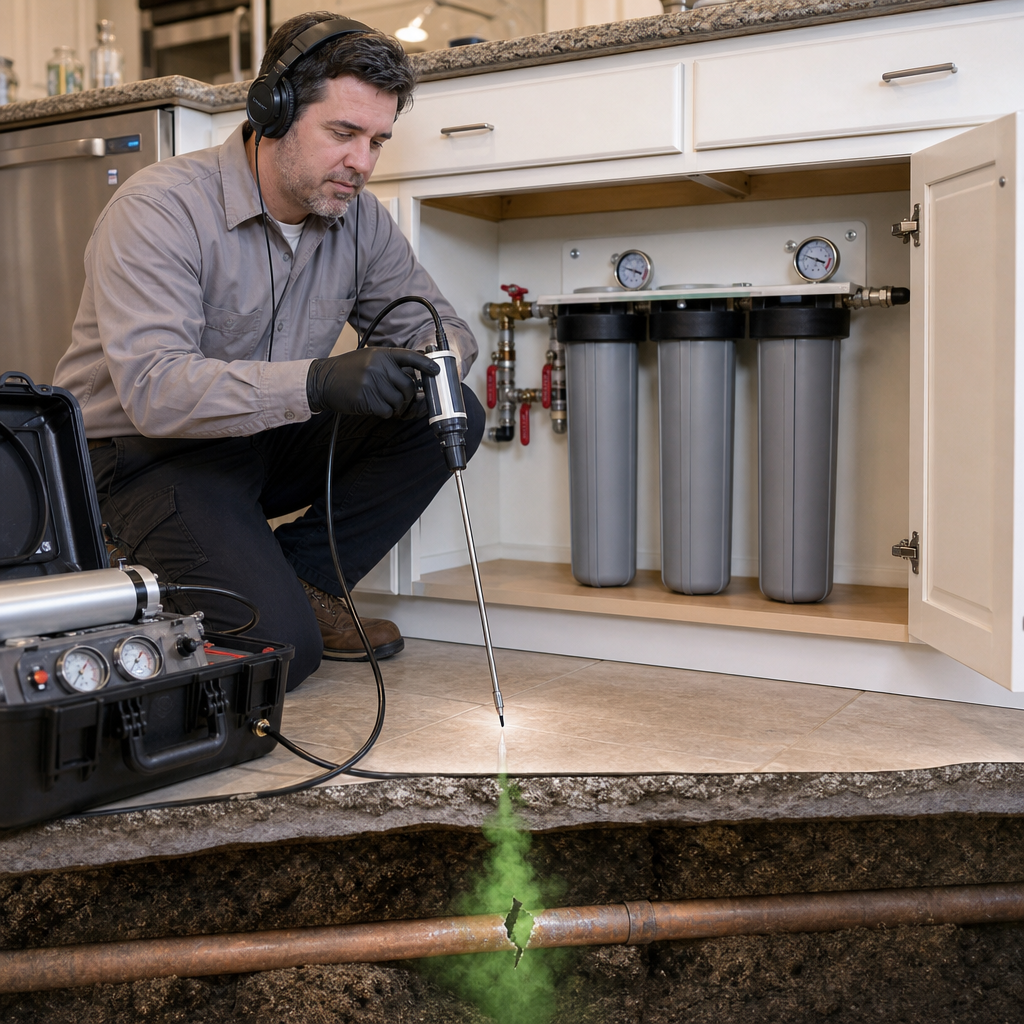
Tracer gas detection involves pressurizing your plumbing lines with a harmless, odorless gas mixture (nitrogen and hydrogen). If a pipe is cracked, the gas escapes into the soil around it. We then use a sensitive probe to detect where that gas is emerging at the surface.
This method is remarkably reliable because the gas travels through soil and emerges exactly where water would escape. We walk the probe slowly over your foundation and yard, and it alerts us when it detects the tracer gas above the leak. This pinpoints the leak location with exceptional accuracy, often to within inches.
Tracer gas is safe, completely non-toxic, and leaves no residue. It’s especially effective for small hairline cracks that might not leak enough water to show up on thermal imaging or acoustic testing. The gas method bypasses soil density issues that can sometimes mask leaks on other detection systems.
What to do next: If you’ve had inconclusive results with other methods, or if you suspect a small slow leak causing gradual water loss, tracer gas detection is an excellent next step. We’ll schedule a same-day response when you call 949-235-1188.
5. Pressure Testing Systems – Confirming Leaks with Safe Pressure Analysis
Pressure testing confirms whether a leak actually exists and how severe it is. We isolate sections of your plumbing system and pressurize them with water or air at safe levels, then monitor whether pressure drops over time. A steady pressure drop indicates an active leak.
This method tells us definitively whether a problem exists before we invest in more localized testing. It’s also useful for ruling out false positives from other methods. We can test specific lines separately, so if you have both a hot water line and a cold water line under your slab, we identify which one is leaking.
Pressure testing is controlled, safe, and gives us quantifiable data. You can see the results yourself on our pressure gauge. The readings document how quickly pressure decays, which helps us estimate leak severity and urgency. This information shapes our repair recommendations and timeline.
What to do next: We typically use pressure testing early in the diagnostic process to confirm a leak exists. Once confirmed, we move to localization methods like acoustic or thermal imaging to pinpoint the exact spot.
6. Video Inspection Cameras – Visual Confirmation Through Your Existing Plumbing Lines
Video inspection involves feeding a small, high-resolution camera through your plumbing lines to visually inspect pipe condition from the inside. The camera sends real-time footage to a monitor we carry with us, showing cracks, corrosion, tree root intrusion, and other damage.
This is particularly valuable when we suspect the leak is in an accessible section of pipe, or when you want a clear before-and-after picture of what we’re dealing with. Video inspection removes all guesswork; you’re seeing exactly what the pipe looks like. We can identify not just the leak point but also areas of concern that might fail soon, allowing us to plan comprehensive repairs rather than temporary fixes.
Orange County homes built before the 1990s often have pipes prone to corrosion or fracture. Video inspection reveals these problems early, sometimes before they become emergency situations. The visual record also proves helpful if you need to file insurance claims or document the condition for future reference.
What to do next: Video inspection is best used once we’ve narrowed down the general problem area. Schedule a free estimate by calling 949-235-1188, and we’ll determine if video inspection makes sense for your situation.
7. Moisture Mapping – Identifying Wet Zones Before Major Damage Occurs
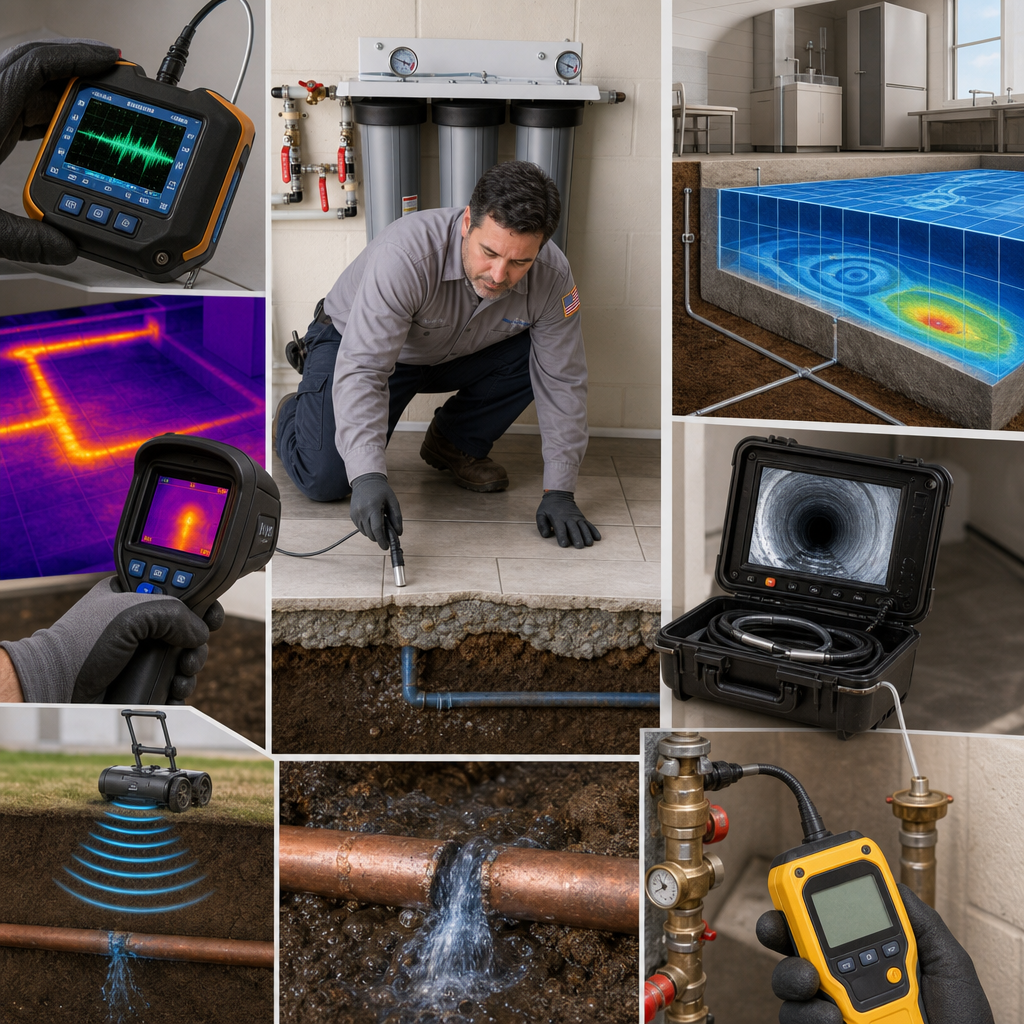
Moisture mapping uses specialized sensors to detect water saturation in soil and foundation materials around your home. By testing multiple points across your slab and foundation perimeter, we create a moisture profile that shows us where water is accumulating.
This approach is particularly valuable because it reveals emerging problems before they cause visible damage. A wet zone under your foundation today might become a catastrophic leak tomorrow. Early detection through moisture mapping lets us catch issues at the least expensive stage, when remediation is straightforward and costs are minimal.
We use calibrated moisture meters to test soil samples at various depths, documenting readings that give us a clear picture of water distribution beneath your home. This data guides our localization efforts and helps us understand the severity of the situation. The moisture map becomes a diagnostic tool that informs repair strategy and helps us explain your options with confidence.
What to do next: Moisture mapping is often combined with other methods to build a complete picture. If you suspect a slow leak or want preventive testing, we recommend an on-site inspection. We’ll diagnose and explain your options in plain language.
—
The old approach to slab leak detection was expensive, disruptive, and often hit-or-miss. Contractors would have to excavate large sections of your foundation based on educated guesses, hoping they’d find the leak and not hit other utilities in the process.
Modern non-destructive methods eliminate that guesswork. We can confidently locate your leak without breaking concrete, damaging landscaping, or disrupting your life. Once we know exactly where the problem is, our repair recommendations become precise and cost-effective.
We combine multiple detection methods to build absolute certainty about your leak’s location and severity. We don’t rely on one technology alone. This redundancy protects you by ensuring we get it right the first time.
Your next step is straightforward. Call us at 949-235-1188 for immediate 24/7 emergency service or to schedule a free estimate. We serve all of Orange County with licensed, insured technicians who have spent over 25 years perfecting leak detection and repair. We’re confident in our diagnosis, committed to your satisfaction, and ready to explain every option in terms you understand.
Don’t let a slab leak drain your budget. Early detection is your greatest defense.
For further reading: Slab leak vs surface plumbing.