

Table of Contents
- 1. Understanding What Your Sewer Camera Shows You
- 2. Identifying Tree Root Intrusions and Blockages
- 3. Recognizing Cracks, Breaks, and Structural Damage
- 4. Evaluating Grease Buildup and Scale Deposits
- 5. Assessing Pipe Misalignment and Offset Issues
- 6. Determining When Spot Repair vs. Full Repiping Makes Sense
- 7. Why Professional Interpretation Beats DIY Analysis
- 8. Getting a Clear Action Plan and Cost Estimate
- Frequently Asked Questions (FAQ)
1. Understanding What Your Sewer Camera Shows You
You’ve had a professional sewer camera inspection done, and now you’re staring at a report full of findings. Maybe there’s mention of root intrusion, cracks, or misalignment. But what does it all actually mean? And more importantly, what should you do about it?
A sewer camera inspection (also called a video inspection or CCTV inspection) gives us a live look inside your underground sewer line. It’s the most reliable way to see what’s really happening without digging up your yard. The challenge is that the report itself can feel overwhelming if you’re not trained to read it.
We’ve spent 25 years interpreting these reports for Orange County homeowners, and we’ve learned that most people just need someone to explain the findings in plain language and recommend a clear path forward. That’s exactly what this guide does. Below, we’ll walk you through the seven key ways to evaluate what your sewer camera inspection report is telling you, so you can make confident decisions about your sewer line.
A sewer camera is a small, waterproof video camera on a flexible cable that travels through your sewer line from a clean-out access point (usually near your home’s foundation). As it moves, it captures real-time video of the pipe’s interior. The technician controls the camera and notes the location, depth, and condition of any issues encountered.
Your inspection report will include timestamps, distance measurements (how far down the line each issue appears), and descriptions of what the camera found. Some reports include still photos or video clips highlighting problem areas. The camera records orientation too, so we can tell you exactly where damage is located (for example, “tree root at the 8-foot mark, on the east side of the line”).
Here’s what makes this valuable: unlike guessing based on backup symptoms or digging exploratory holes, a camera inspection gives us certainty. We can see if your line is blocked, deteriorating, or structurally sound before we recommend any repairs.
What to do next: Review your report for the date, the starting and ending points of the inspection, and a summary section. This gives you context for everything that follows.
2. Identifying Tree Root Intrusions and Blockages
Tree roots are one of the most common sewer line problems we encounter in Orange County. Roots don’t actually break the pipe, but they grow into small cracks or joints seeking moisture. Once inside, they create tangled masses that trap grease, debris, and toilet paper, causing slow drains and backups.
On your sewer camera report, root intrusion appears as fine, hair-like roots protruding from joints or small cracks into the pipe. Sometimes the entire pipe looks like it’s been invaded by roots. Severity varies: light root intrusion might cause occasional slow drainage, while heavy intrusion can completely block the line.
If your report mentions roots, note the severity level (light, moderate, or heavy) and the location. A single small root patch 15 feet from your clean-out is less urgent than roots spanning the entire visible section. Also check if the report notes any collapse or structural damage caused by the root activity. Roots weaken pipes over time, so even moderate intrusion deserves attention sooner rather than later.
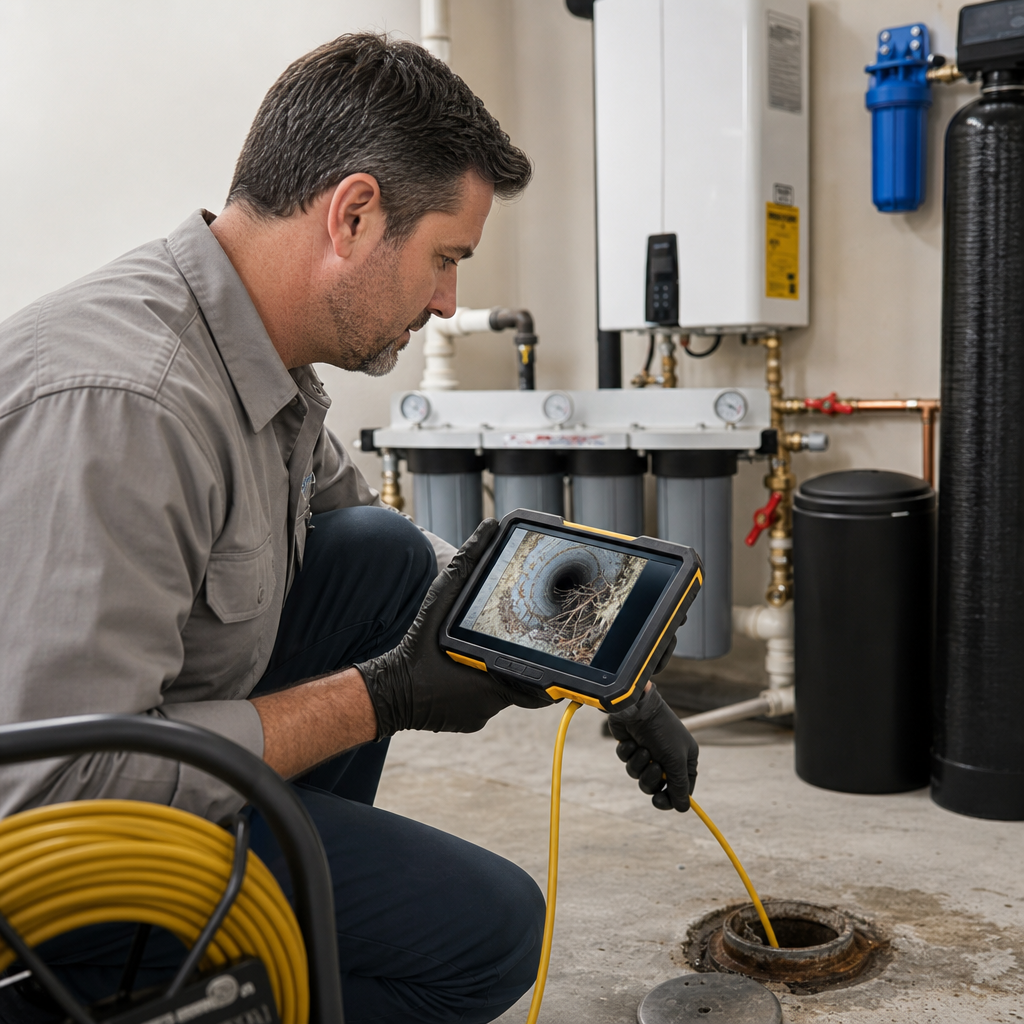
What to do next: If roots are noted, ask whether the line is still draining (partially blocked) or completely blocked. Partial blockages can sometimes be cleared with a rooter service, while heavy root intrusion often signals that spot repair or repiping is necessary.
3. Recognizing Cracks, Breaks, and Structural Damage
Cracks and breaks are different problems with different solutions. A crack is a fracture in the pipe material that doesn’t go all the way through. A break (or fracture) is a complete separation of the pipe sections. On video, cracks look like thin lines running along the pipe, while breaks show offset, misalignment, or gaps between segments.
Structural damage might also include collapse (where the pipe has caved in) or corrugion (deterioration of the pipe material). Cast iron and clay pipes are especially prone to corrosion and cracking as they age. PVC pipe (plastic) is more durable, but it can still crack under ground stress or tree root pressure.
Your report should indicate the size and location of any cracks or breaks. A hairline crack near a pipe joint is often less critical than a long, wide fracture. However, even small cracks allow water to seep out (and soil and roots to seep in), so they do require monitoring and eventual repair.
What to do next: Ask your technician whether the damage is localized (one area) or widespread (multiple sections). This determines whether a spot repair is realistic or if the entire line needs replacement.
4. Evaluating Grease Buildup and Scale Deposits
Grease buildup and mineral scale deposits don’t typically require camera inspection to spot (you’ll notice slow drains first), but the camera report confirms their extent and location. Grease accumulates as a sticky coating on the pipe walls, especially in older lines where grease was regularly poured down the drain. Scale is mineral buildup, typically calcium deposits in areas with hard water.
On video, grease appears as a brownish or tan coating, sometimes with visible blockages where grease has solidified. Scale looks like white or grayish deposits crusted on the pipe walls. Both reduce the pipe’s internal diameter and slow water flow.
The key question is whether the buildup is causing an active blockage or just coating the walls. If the camera can still pass through without resistance, the blockage is partial. If the camera gets stuck or can’t reach the end of the line, you have a more serious clog. Grease and scale can sometimes be cleared with hydrojetting (high-pressure water cleaning) without needing pipe replacement.
What to do next: If grease or scale is noted, ask whether it’s the primary cause of any drainage issues you’re experiencing. If so, hydrojetting might be a quick, non-invasive solution before considering more extensive repairs.
5. Assessing Pipe Misalignment and Offset Issues
Misalignment occurs when two sections of pipe are no longer lined up properly. This can happen due to ground settling, earthquake activity, tree roots, or age. When pipe sections offset, water still flows, but it creates a low point where debris and grease collect, leading to blockages.
On a camera report, misalignment shows as a visible step or gap where two pipe sections meet. The report should note how much offset exists (measured in inches). Even a half-inch offset can trap debris. A two-inch or greater offset is more severe and reduces flow capacity significantly.
Orange County’s expansive soil and older neighborhoods often see settling-related misalignment. We typically see this in homes built in the 1950s through 1980s on clay or sandy soil. The ground shifts, and the rigid sewer line shifts with it.

What to do next: If the report notes misalignment, ask whether it’s causing active drainage problems or if it’s a future risk. Minor offsets that aren’t causing issues might be monitored, while severe misalignment usually warrants repair to prevent costly blockages down the road.
6. Determining When Spot Repair vs. Full Repiping Makes Sense
This is the critical decision point, and it’s where homeowners often get confused. Your report might show damage, but does that mean you need to replace your entire sewer line, or just fix the problem area?
Spot repair makes sense if:
- Damage is isolated to one small section (typically less than 2 feet)
- The rest of the line is in good structural condition
- The damaged area is accessible without major excavation
Full repiping is more appropriate if:
- Multiple problem areas exist throughout the line
- The pipe is old, corroded, or shows widespread cracks
- Damage is in multiple locations or severe collapse is present
- Previous spot repairs have failed
Here’s the reality: a spot repair on a 50-year-old line that’s deteriorating elsewhere is often a temporary fix. You might invest $2,500 to $4,000 in a spot repair, only to face another problem two years later. Full repiping costs more upfront (typically $5,000 to $15,000+ depending on line length and soil conditions), but it solves the problem comprehensively.
What to do next: After reviewing the camera report, ask your technician to assess the overall condition of the entire line, not just the immediate problem. We’ll help you understand the full picture and recommend the most cost-effective solution.
7. Why Professional Interpretation Beats DIY Analysis
You can read a sewer camera report on your own, but interpreting it requires training and experience. Here’s why: the same image can mean different things depending on context.
For example, a root seen at the 20-foot mark could be a minor intrusion that doesn’t need immediate attention, or it could be the leading edge of a much larger root mass that will worsen quickly. A crack might be stable and decades old, or it might be actively growing. A slight offset could be harmless or the sign of ongoing ground movement.
We’ve also learned that technicians sometimes include findings that aren’t urgent or actionable. A homeowner reading the report might panic thinking every issue requires immediate repair, when in reality, only one or two findings actually need your attention right now. Professional interpretation separates critical findings from minor observations.
Additionally, we factor in your home’s age, soil type, drainage patterns, and history of issues. A 1970s home with clay pipe in Orange County’s coastal area has different risk factors than a newer home with PVC. We use all of this context to guide your decision.

What to do next: Don’t rely solely on the written report. Schedule a consultation with a licensed plumber who can review the video with you, answer your specific questions, and explain what repairs are truly necessary versus what can wait.
8. Getting a Clear Action Plan and Cost Estimate
Once you understand your sewer camera inspection findings, the next step is a clear, prioritized action plan. This should include:
- Which issues are urgent (active blockages, major structural damage)
- Which issues can be monitored or deferred (minor cracks, light root intrusion)
- What repair method we recommend for each problem
- Estimated costs for each option
A good action plan also includes preventive steps. If your report shows root intrusion, we might recommend regular rooter maintenance every 1 to 2 years to prevent future backups. If grease is the culprit, we’ll discuss drain care habits to prevent recurrence. If your pipe is nearing the end of its life, we might recommend planning a repiping project over the next few years rather than facing an emergency.
You should never feel pressured to fix everything at once. We’re happy to work with your timeline and budget, addressing the most critical issues first.
What to do next: Call us at 949-235-1188 for a free estimate and detailed explanation of your camera inspection findings. We’ll review your report with you, answer all your questions, and create a straightforward plan that makes sense for your home and your situation. Our 24/7 emergency service means we’re always available when you need us, and our 100% satisfaction guarantee means you can trust that we’re recommending what’s truly best for your sewer line.
For further reading: Recognizing common plumbing issues.
Frequently Asked Questions (FAQ)
What should I look for when reviewing my sewer camera inspection report?
We recommend focusing on four key areas: the overall condition of your pipe walls, any visible cracks or breaks, tree root intrusions, and debris buildup like grease or scale. When we perform the inspection, we’ll walk you through the video footage and highlight specific problem areas so you understand exactly what we found. Our goal is to make sure you can see the issues yourself rather than just taking our word for it.
How do I know if my sewer line needs spot repairs or full repiping?
That depends on the location, severity, and number of problems we discover during your inspection. If we find isolated damage in one section, spot repair may be the right choice. However, if we’re seeing multiple cracks, extensive root intrusion, or misalignment across your line, we’ll recommend repiping to avoid repeated failures down the road. We’ll provide you with a no-obligation quote for both options so you can make an informed decision.
Why should I have a professional interpret my sewer camera results instead of doing it myself?
We’ve been analyzing sewer inspections for over 25 years, and experience makes a real difference in identifying what’s actually a threat versus what’s just normal wear. Small cracks that appear minor on video can signal bigger structural problems, and we know which issues demand immediate attention and which ones we can monitor. We’ll diagnose and explain your options in plain language, then create a clear action plan tailored to your situation. Call us at 949-235-1188 to schedule your inspection today.